US Inflation Hysteria: Inflation Sends the Bill; the Balance Sheet Decides Who Pays
Headline inflation metrics obscure a harsher corporate reality: rising prices do not guarantee stronger earnings. As input and replacement costs escalate, businesses require vastly more capital simply to sustain existing capacity. While nominal growth may flatter reported figures, the true burden falls unevenly across corporate balance sheets. Explore how…
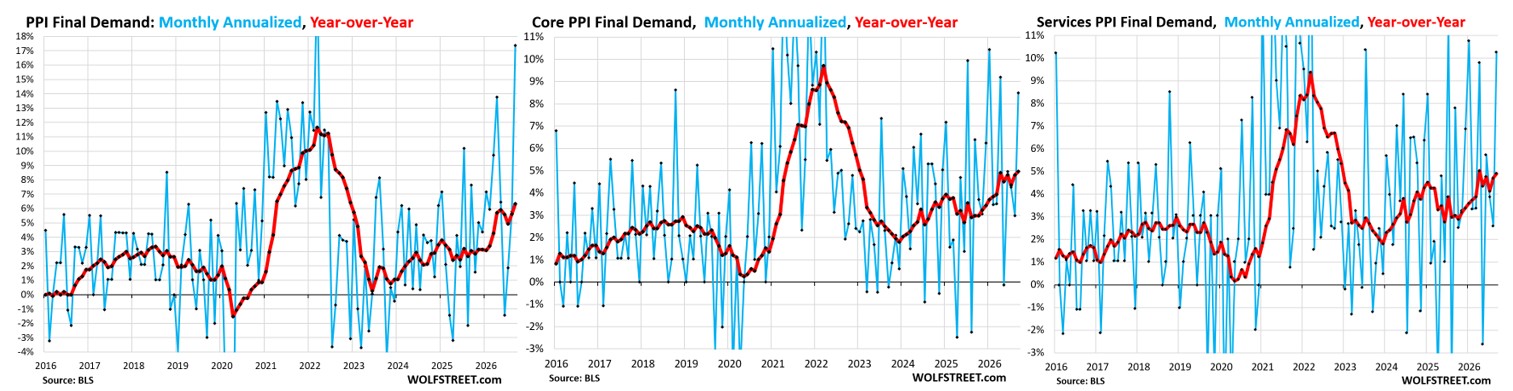
Yesterday, we suggested that inflation does not need to return to 9% to raise the cost of capital. September’s PPI adds a less comfortable question: how much additional capital will companies need simply to keep doing the same thing? Final-demand prices rose by 1.3% month-on-month and 6.3% year-on-year, the largest annual increase since December 2022. Even excluding food, energy and trade services, the increase reaches 5% year-on-year. Oil explains a substantial part of the shock; it does not absolve everything else.
We should, however, avoid buying wholesale into the headline that “businesses face much higher inflation than consumers.” The PPI measures prices received by domestic producers, not a uniform bill for corporate costs; trade services, moreover, measure distribution margins. An increase may reflect some intermediaries defending their remuneration, rather than everyone being squeezed. Comparing 6.3% PPI inflation with 3.7% CPI inflation does not establish an equivalent contraction in margins, nor does it identify inflation waiting to be passed automatically through to consumers. The relevant question would be who manages to charge the new price and who has to pay it without being able to pass it on. Inflation does not send everyone the same bill, however determined some may be to summarise it with a single decimal place.
This distinction connects with what we have been discussing since July: upstream pricing power and downstream buyer resistance. Processed goods for intermediate demand are now up 14.1% year-on-year, while intermediate services are up 6.3%. These figures do not, on their own, predict the next CPI reading, but they do warrant reviewing how the operating cycle is financed. With quantities and payment terms unchanged, replenishing more expensive inventories or financing larger receivables requires more money before payment is collected. A company could maintain its percentage margin and still convert less profit into cash. Nominal growth would look splendid in the presentation; the credit facility would have a less enthusiastic opinion.
Another bill tends to arrive with a lag: replacing productive capital. Depreciation calculated on historical costs can provide an accounting picture that is correct, yet economically inadequate, of what it costs to sustain the business. While the machinery keeps running, the difference causes little discomfort; when it becomes obsolete, needs replacing or capacity must be expanded, the updated quotation arrives. We might then discover that selling prices and accumulated cash are insufficient to recover the new investment at an acceptable rate of return. Not necessarily because the business has stopped selling, but because preserving its productive capacity requires considerably more capital than its accounts suggested.
Without turning this into an excursion into Tobin’s q—the relationship between market valuation and the replacement cost of assets—the intuition behind it deserves a seat at the table: the capital installed yesterday and the capital that must be financed tomorrow do not necessarily cost the same. A low depreciation charge can flatter earnings without making a single machine cheaper. And part of what appeared to be cash available to shareholders could, in fact, be maintenance capital expenditure not yet recognised as a requirement. The dividend would then be less generous than it looks: we would be distributing a portion of tomorrow’s factory today. That is assuming this does not also force the company to raise equity or issue debt.
Here, the Fed’s latest comments offer something more useful than another debate over twenty-five basis points. In the remarks compiled this week, Hammack notes that higher interest rates could restrain companies in other sectors without deterring the major technology investors; Goolsbee distinguishes between disruptions that might fade and AI-related demand overheating that would require a response. Williams, meanwhile, still expects inflation to approach 2% next year. The tension is not merely between optimists and the more cautious: the monetary policy instrument could have its strongest effect on those contributing least to the engine of spending.
Perhaps this captures much of what we can expect from Warsh and the Usual Suspects: acknowledging, with varying degrees of elegance, the limits of their tools when the Fifth Horseman of the Apocalypse has been riding for some time. They cannot print chips, oil or electricity capacity. They can restrict credit and cool demand; saying they have no tools at all would hand them an excessively convenient alibi. What they cannot guarantee is that the adjustment will fall on those generating the greatest pressures, or that it will be painless for everyone else.
That leaves them with a less photogenic option: tightening enough for part of the economy to stop competing for those resources. They do not have to set out to bring it down to end up doing considerable damage. How far would they be prepared to go, Volcker-style, if inflation persists? Trump will surely have a very explicit answer as to what they should do; a different question is how much political and financial cost they would be willing to accept to do the opposite. We do not need to assume that this confrontation has been settled to recognise that it would condition the credibility of any monetary policy promise.
If the asymmetry persists, the adjustment could fall first on housing, small businesses and conventional investment, while the most liquid balance sheets continue competing for energy, equipment and physical capacity. AI’s future productivity gains may be real and valuable; what they cannot do is pay in advance the bills of those financing the transition. The savings and resources needed today do not materialise because a presentation promises abundance tomorrow. That is the difference between welcoming a technological revolution and assuming that any financial structure can survive until its rewards arrive.
For the Prudent Man, perhaps the most revealing test is not how much a company can raise prices, but how much cash it retains after replenishing inventories, genuinely maintaining its productive capacity and servicing its debt. It is worth examining depreciation alongside current replacement costs, not confusing deferred investment with a requirement that has disappeared, and checking whether dividends are being paid out of surplus cash or by running down the business. Liquidity and financial autonomy, yes—but purchased at a valuation that does not require getting disinflation, refinancing and customer patience right simultaneously.
Because selling at higher prices does not always mean earning more; sometimes it means needing more capital to preserve exactly the same business.